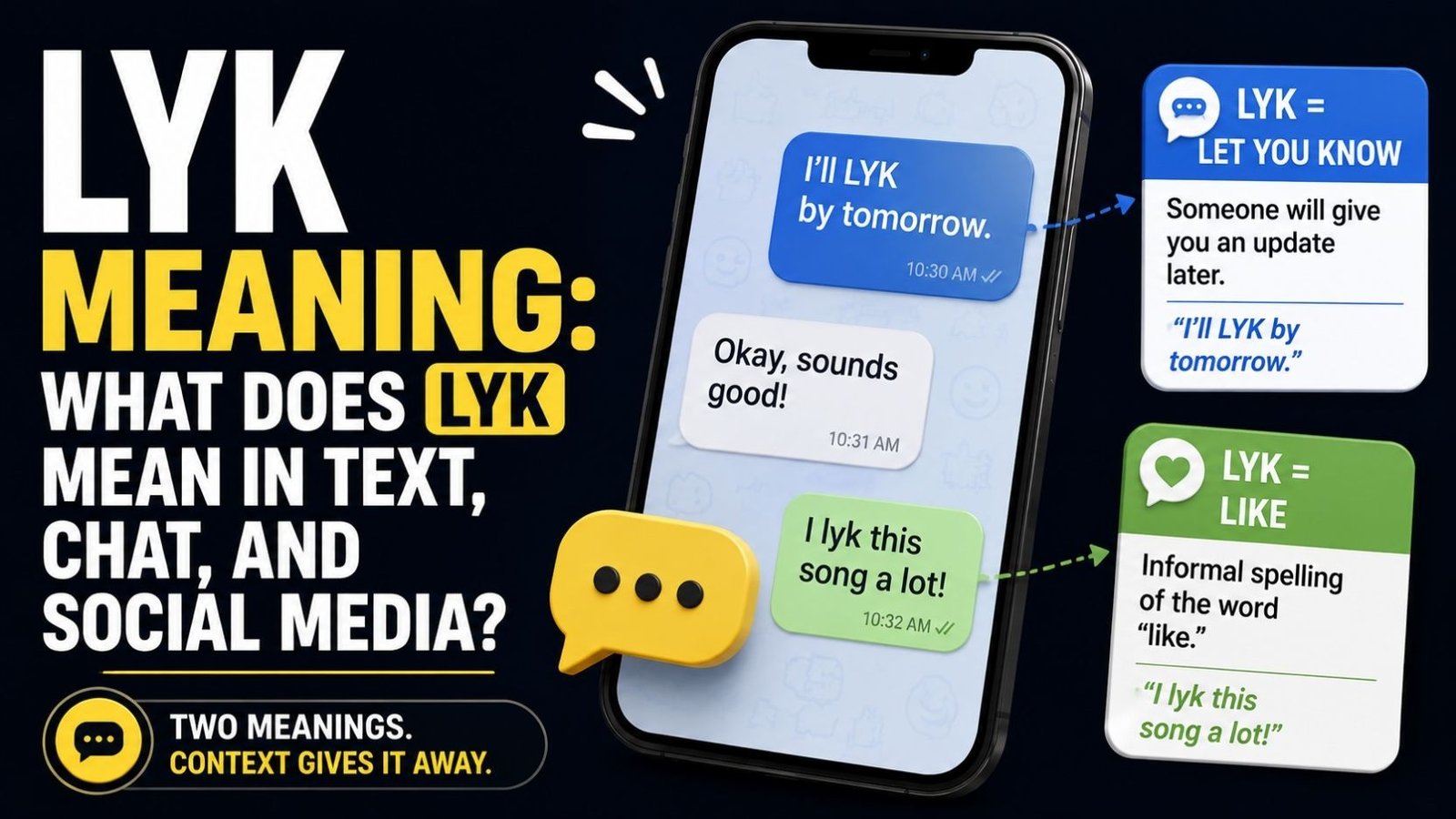
LYK is a short piece of texting slang, and it actually carries two different meanings depending on how it’s used. Most often, LYK stands for “let you know,” used when someone plans to send you an update later. Less commonly, “lyk” is simply a quick, informal spelling of the word “like.”
Both uses are common, so the trick is figuring out which one fits the sentence you’re reading. This guide breaks down each meaning clearly, shows you how to tell them apart, and covers pronunciation, origin, examples, and the small mistakes people make with it.
The Two Meanings of LYK
LYK doesn’t have one official dictionary definition. It’s internet shorthand, and its meaning shifts based on context. Here are the two versions you’ll run into.
Meaning 1: “Let You Know”
This is the more common meaning in everyday texting. When someone writes “I’ll LYK,” they mean “I’ll let you know.” It’s used when a person doesn’t have an answer yet but promises to follow up once they do.
- “Not sure if I’m free Saturday, I’ll LYK.”
- “Waiting on my manager. I’ll LYK by tomorrow.”
- “Let me check the schedule and LYK.”
In this sense, LYK works almost like a placeholder. It tells the other person: I heard your question, I don’t have the answer right now, and I’ll come back to you.
See More: What Does IKK Mean In Text?
Meaning 2: An Informal Spelling of “Like”
The second meaning is simpler. Some people type “lyk” instead of “like,” usually to save a keystroke or to match a casual, low-effort texting style.
- “I lyk this song.”
- “She lyk him a lot.”
- “Everyone lyk that post.”
Here, “lyk” isn’t an acronym at all. It’s just a shortened spelling, similar to how people write “u” for “you” or “ur” for “your.”
How to Tell the Two Meanings Apart
Context almost always makes the meaning obvious. A simple way to check:
| Clue in the sentence | Likely meaning |
| Comes after “I’ll,” “I will,” “ima,” or “imma” | Let you know |
| Comes right before a noun or object (“lyk this,” “lyk him”) | Like |
| Used as a verb of preference (“I lyk pizza”) | Like |
| Used as a promise to follow up later | Let you know |
| No object follows it, sentence feels unfinished without more info | Let you know |
If you can naturally swap in the phrase “let you know” and the sentence still makes sense, that’s your answer. If “like” fits better, that’s the one being used.
LYK In Different Places
LYK In Text Messages
In SMS and iMessage conversations, LYK usually shows up as “let you know,” especially when people are making plans.
- “Can’t say yet, I’ll LYK once I check my calendar.”
LYK In WhatsApp
WhatsApp conversations, especially ones about logistics, meetups, or work, lean heavily toward the “let you know” meaning.
- “Still discussing with the team, will LYK soon.
LYK On Instagram
On Instagram, especially in comments and captions, “lyk” more often shows up as the informal spelling of “like.”
- “I lyk your outfit 🔥”
- “lyk if you agree”
LYK From A Girl (Or Anyone)
There’s no hidden or gender-specific meaning behind LYK. If a girl, guy, or anyone else texts “I’ll LYK,” it means the same thing it always does: they don’t have an answer yet and will update you.
It’s not a secret signal, and it doesn’t carry a different tone based on who sends it. The actual meaning still depends on context, not the sender.
Grammar And Part Of Speech
LYK itself isn’t a standard part of speech since it’s an informal abbreviation, not a recognized word. But depending on which meaning is intended, it behaves differently in a sentence.
- When it means “let you know,” it functions as a verb phrase: “I’ll LYK” = “I will let you know.”
- When it means “like,” it takes the place of the verb “like”: “I lyk this” = “I like this.”
Neither use belongs in formal writing. LYK is informal texting shorthand, appropriate for casual chats, DMs, and group messages, not for emails to a boss, professional reports, or school essays.
See More: NPC Meaning Slang
Pronunciation
LYK is almost never spoken out loud. It exists mainly in written texting and typing. If someone does say it aloud, they usually spell it out letter by letter: “L, Y, K.” It isn’t pronounced as a single word the way acronyms like “lol” sometimes are.
Where LYK Came From
LYK developed the same way most texting abbreviations did: people needed to type faster on small keyboards, and shortening common phrases became the norm. “Let you know” is a phrase used constantly in daily conversation, so trimming it down to three letters was a natural shortcut once texting and instant messaging became widespread.
The “like” spelling of “lyk” followed a similar pattern but for a different reason. Dropping the “i” from “like” doesn’t save much typing time, but it fits a broader texting habit of restyling common words (similar to “wat,” “dat,” or “sum”) to create a more casual, stylized tone.
Examples In Full Conversations
Making plans:
Sam: Are you coming to the game Friday? Alex: Not sure yet, depends on work. I’ll LYK by Thursday.
Waiting on approval:
Coworker: Did the client sign off on the proposal? You: Not yet. Still waiting. Will LYK as soon as I hear back.
Using it as “like”:
“Ngl I lyk this a lot more than the last one.”
Common Mistakes With LYK
❌ Incorrect: Using LYK in a formal email to a client.
✅ Correct: “I will let you know by end of day.”
❌ Incorrect: Assuming LYK always means “like.”
✅ Correct: Check whether it follows “I’ll” or “will” — that usually signals “let you know” instead.
❌ Incorrect: Confusing LYK with LMK.
✅ Correct: LMK means “let me know” (someone is asking you for information). LYK means “let you know” (someone is telling you they’ll provide information). They point in opposite directions.
LYK Vs Similar Abbreviations
| Abbreviation | Meaning | Difference |
| LYK | Let you know / like | Can mean two different things depending on context |
| LMK | Let me know | The speaker is asking to be informed, not offering to inform |
| IDK | I don’t know | Expresses uncertainty only, no promise to follow up |
| FYI | For your information | Shares information immediately rather than promising it later |
| IYKYK | If you know, you know | An unrelated phrase about shared or inside knowledge |
Is LYK Appropriate To Use?
LYK is fine in casual texting, group chats, and informal messages between friends, classmates, or coworkers who already use shorthand with each other. It’s not appropriate in:
- Formal emails
- Academic writing
- Professional reports
- Messages to someone you don’t know well, especially in a workplace setting
When in doubt, spell out the full phrase. It reads as more polished and avoids any confusion about which meaning you intend.
See More: GNG Meaning In Text
Frequently Asked Questions
What does LYK mean In text?
It most commonly means “let you know,” used when someone will provide an update later. It can also mean “like,” used as an informal spelling.
What does LYK mean On Instagram?
On Instagram, “lyk” is more often the informal spelling of “like,” especially in comments and captions.
What does LYK mean on WhatsApp?
On WhatsApp, LYK almost always means “let you know,” since WhatsApp conversations tend to involve real plans and logistics.
Is LYK a noun or a verb?
It isn’t a standard part of speech, but it functions as a verb phrase in both of its meanings.
How do you pronounce LYK?
It’s rarely spoken aloud. When it is, people usually say the letters individually: L, Y, K.
Is it okay to use LYK in a work email?
It’s best avoided in formal or professional writing. Spell out “I’ll let you know” instead.
Final Thoughts
LYK is a small abbreviation, but it does double duty. Most of the time, it means “let you know,” a quick way of saying you’ll follow up once you have more information. Other times, especially in comments or casual captions, it’s just a stripped-down spelling of “like.”
The good news is that context makes the meaning easy to spot almost every time. Once you know to check whether it follows “I’ll” or sits next to a noun, you’ll never have to guess what someone meant by “lyk” again.

Zoya Ahmed is the author of Means Wiki, dedicated to making words, names, phrases, and slang easier to understand. With 4 years of experience, she researches and writes simple, accurate, and useful explanations to help readers quickly discover meanings and better understand everyday language.
2 Comments