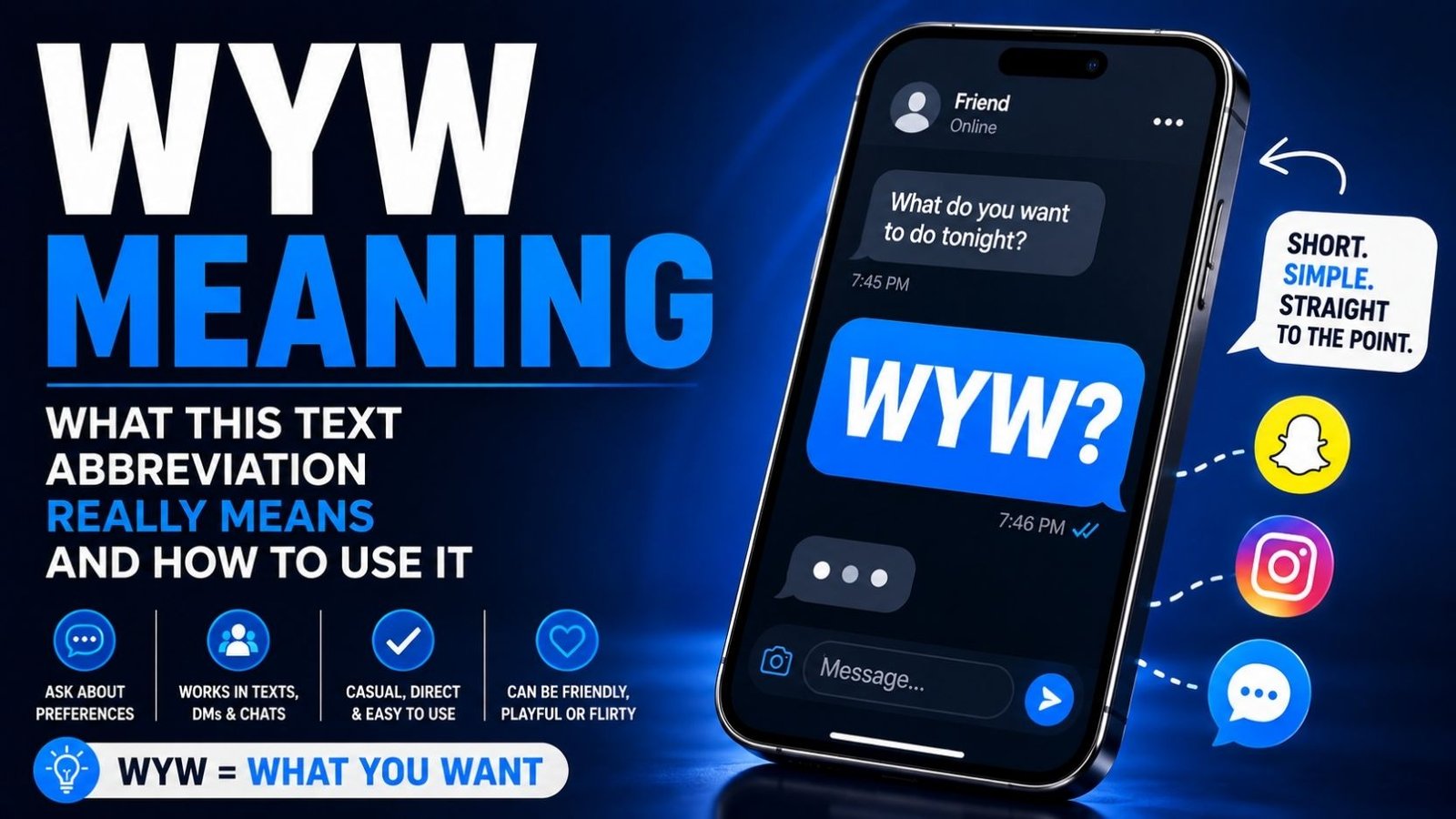
WYW is a texting abbreviation that usually means “What You Want.” People use it to ask someone what they need, prefer, or feel like doing in that moment. You will see it in text messages, Snapchat, Instagram DMs, and other casual chats. It works almost like a shorter, more relaxed version of “What do you want?”
The meaning of WYW rarely changes, but the tone behind it can shift a lot. A friend asking WYW about dinner sounds completely different from someone asking WYW during a tense conversation.
Understanding that context matters just as much as the definition. This guide breaks down the meaning, grammar, common uses, and small details that make WYW easy to understand and easy to use correctly.
What Does WYW Mean?
WYW stands for “What You Want.” It is an informal shorthand that drops the helping verb “do,” which is common in fast, casual texting. Instead of typing “What do you want?”, someone simply types “WYW?” and expects the reader to fill in the missing grammar naturally.
This clipped style is typical of internet slang. Speed and simplicity matter more than strict grammar in a text thread. Because of that, WYW can also be read informally as “Whatcha want” or “What do you want,” depending on the surrounding context.
Quick definition:
- WYW = What You Want
- Type of phrase: Informal question abbreviation
- Common use: Asking about someone’s preference, plan, or need
- Tone: Casual, direct, sometimes playful or flirty
See More: WTV Meaning In Text
WYW Meaning In Text
In a regular text conversation, WYW is almost always a simple, practical question. Someone uses it when they want a fast answer without typing a full sentence.
For example, if two friends are figuring out weekend plans, one might text “WYW today?” That message is just asking what the other person feels like doing. There is no hidden meaning. It works the same way “What’s up?” or “You free?” works: a quick, low-effort way to open or continue a conversation.
Common situations where WYW appears in texting:
- Deciding what to eat or order
- Planning an activity or hangout
- Asking someone what they need help with
- Checking what someone prefers between two choices
- Following up after a vague or unclear message
WYW Meaning In Text from A Guy
When a guy sends “WYW,” the meaning itself does not change. He is still asking what you want. What shifts is the context and intent behind the question.
If the conversation is casual and friendly, WYW is simply an easy way to keep the chat going or ask about plans. If the conversation has a flirty or romantic tone already, WYW can be an invitation to share what you’re interested in, whether that means plans together, attention, or simply keeping the conversation open. The words stay the same. The relationship and the tone around the message are what reveal the intent.
A simple way to judge intent:
- If earlier messages are playful or complimentary, WYW likely continues that tone.
- If the conversation has been purely practical, WYW is probably just about logistics.
- If you’re unsure, a short reply like “Depends, what did you have in mind?” naturally clarifies things without overthinking it.
WYW Meaning From A Girl
The same logic applies when a girl sends WYW. It is not a gendered phrase, and it does not carry a different core meaning based on who sends it. A girl asking WYW is asking the same question a guy would: what do you want, prefer, or feel like doing right now?
Tone and context still decide how the message should be read. In a friend group chat, WYW from a girl is almost certainly about plans or preferences. In a one-on-one conversation with more personal messages already exchanged, it can carry a lighter, more personal undertone. The safest approach is always to read the surrounding messages rather than assuming meaning from the abbreviation alone.
WYW Meaning On Snapchat
WYW meaning on Snapchat follows the same base definition, but Snapchat’s format changes how it feels. Because Snapchat conversations are quick, visual, and often built around photos or short clips, WYW fits naturally as a caption or a one-line reply.
Someone might send a photo of two outfits with the caption “WYW me to wear tonight?” Or they might reply to a snap with just “WYW” to ask what the other person wants to do next. On Snapchat, WYW often works as a quick check-in, especially between people who talk regularly through snaps rather than long texts.
WYW Meaning On Instagram
WYW on Instagram means very much the same as in DMs and comments elsewhere. It commonly appears in direct messages when someone is asking a follower, friend, or match what they are interested in.
It also shows up in comments, particularly on posts where a creator is asking their audience for input. A caption like “New content coming, WYW to see next?” is asking followers what they want. This usage keeps the same core meaning but functions as a light engagement tool for creators and casual audiences alike.
WYW Meaning In Chat And Online Conversations
Across chat apps, group messages, and online communities, WYW is used as a fast, informal question. It works especially well in real-time chats, where users want short exchanges instead of full sentences.
In gaming communities and platforms like Roblox, players sometimes use WYW in a similar practical sense, such as asking what another player wants during a trade or negotiation.
In this context, WYW usually means “what item or offer do you want,” matching the same underlying “What You Want” meaning applied to a specific in-game situation. There is no separate, official definition tied to any single game or platform. The letters keep their standard meaning; only the situation around them changes.
See More: HM Meaning In Text
WYW Meaning As Slang
As slang, WYW works because it strips a common question down to its most essential parts. Slang abbreviations like this usually form the same way: remove smaller connecting words, keep the words that carry the meaning.
That’s exactly what happens here. “What do you want” becomes “What You Want,” and then simply “WYW.” This kind of shortening is extremely common across texting slang, which is why WYW fits naturally alongside other everyday abbreviations like “WYD” (What You Doing) or “HBU” (How Bout You).
Grammar And Part Of Speech
WYW itself is not a standard part of speech since it is an abbreviation, not a full word. Grammatically, it represents an interrogative sentence, meaning a sentence that asks a question.
The full form, “What do you want?”, follows normal English question structure:
- What — interrogative pronoun
- do — auxiliary verb
- you — subject pronoun
- want — main verb
In texting shorthand, the auxiliary verb “do” is dropped, which is why WYW literally expands to “What You Want” instead of “What Do You Want.” This is a common and accepted pattern in informal digital writing, even though it would not be considered correct in formal writing.
How To Pronounce WYW?
WYW is typically read as an initialism, meaning each letter is pronounced separately: W-Y-W. It is not usually turned into a spoken word the way some acronyms are.
In casual conversation, some people simply say the full phrase, “What you want,” instead of pronouncing the letters. Both approaches are acceptable, since WYW is mainly a written form used in texting and online chat rather than spoken slang.
Origin Of WYW
WYW developed as part of the broader trend of texting abbreviations that grew alongside SMS messaging and early mobile phones. Character limits and small keyboards encouraged users to shorten common phrases wherever possible.
As texting culture expanded into instant messaging apps and social media, this shortening habit carried over naturally. WYW became one of many casual abbreviations used to keep conversations quick and low-effort, similar to terms like “WYD,” “HMU,” or “TTYL.”
There is no single documented first use of WYW. It grew organically as part of everyday digital communication rather than being introduced by one specific source.
WYW vs Similar Abbreviations
Several text abbreviations look similar to WYW, which is a common source of confusion. Here is how they compare.
| Abbreviation | Meaning | Typical Use |
| WYW | What You Want | Asking someone’s preference or plan |
| WTW | What’s the Word / What’s Up | Casual greeting or check-in |
| WYWT | Wish You Were There | Sharing an experience someone missed |
| WYWH | Wish You Were Here | Expressing that you miss someone somewhere |
| WYD | What You Doing | Asking what someone is currently up to |
These abbreviations look alike because they share short, letter-based patterns, but their meanings are different enough that mixing them up can cause real confusion in a conversation.
Examples Of WYW In Real Sentences
Seeing WYW in context makes the meaning easier to grasp than a definition alone.
- “I’m starving, WYW for lunch?”
- “We can watch a movie or go out, WYW?”
- “WYW, I can help with whichever one you need first.”
Each example keeps the same core meaning: a quick request to know what the other person prefers.
Common Mistakes When Using WYW
A few small mistakes come up often with this abbreviation.
❌ Incorrect: Using WYW in a formal email or professional message.
✅ Correct: “What would you like me to prioritize first?”
❌ Incorrect: Confusing WYW with WYWH or WYWT, which have different meanings.
✅ Correct: Double-checking which letters are actually in the message before replying.
❌ Incorrect: Assuming WYW always has a romantic or flirty meaning.
✅ Correct: Reading the full conversation, since WYW is usually just practical.
See More: Snow Bunny Meaning
Similar And Related Words
A few phrases carry a similar tone or purpose to WYW, even though their wording is different.
| Phrase | Meaning | Difference from WYW |
| WYD | What You Doing | Asks about current activity, not preference |
| HBU | How About You | Redirects a question back to the other person |
| WYWD | What You Wanna Do | Slightly longer, more action focused |
Frequently Asked Questions
What does WYW mean in text?
WYW means “What You Want.” It is a casual way of asking someone what they want, need, or prefer.
Is WYW always flirty?
No. WYW is usually a neutral, practical question. Any flirty meaning comes from the surrounding conversation, not the abbreviation itself.
How do you reply to WYW?
You can reply directly with your preference, such as “WYW pizza sounds good,” or ask a clarifying question if the message feels unclear.
Is WYW a noun or a verb?
WYW is not a single part of speech. It represents a full question, “What do you want,” shortened into an abbreviation.
What is the difference between WYW and WYD?
WYW asks what someone wants. WYD asks what someone is currently doing. They are related but not interchangeable.
Does WYW mean the same thing on every platform?
Yes. The core meaning stays the same on texting, Snapchat, Instagram, and most chat platforms. Only the context around it changes.
Is it okay to use WYW in professional messages?
No. WYW is informal and works best in casual conversations with friends or people you already know well.
What does WYW mean from a guy or a girl specifically?
The meaning does not change based on who sends it. Tone and context, not gender, determine whether the message feels casual or personal.
Conclusion
WYW is a simple, widely used texting abbreviation that means “What You Want.” It shows up across text messages, Snapchat, Instagram, and everyday chat apps as a quick, informal way to ask someone about their preference, plan, or need. The meaning stays consistent no matter where you see it, whether it comes from a friend, a guy, a girl, or a stranger online.
The real skill in understanding WYW meaning is reading the conversation around it. On its own, WYW is a neutral, practical question. Combined with tone, timing, and the relationship between the people texting, it can feel casual, playful, or personal. Once you understand that distinction, replying to WYW becomes easy and natural in any chat.

Zoya Ahmed is the author of Means Wiki, dedicated to making words, names, phrases, and slang easier to understand. With 4 years of experience, she researches and writes simple, accurate, and useful explanations to help readers quickly discover meanings and better understand everyday language.
2 Comments