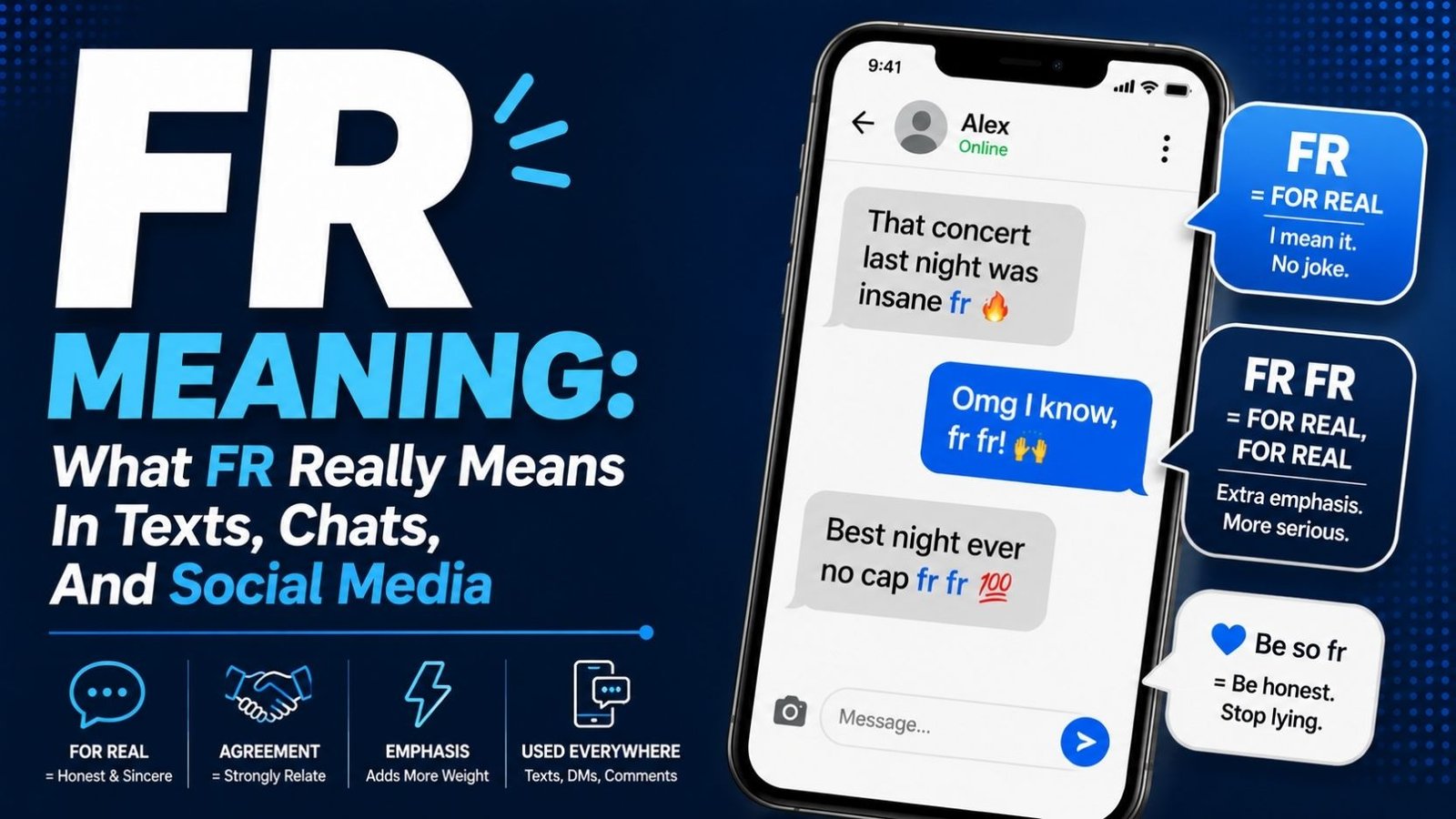
FR means “for real.” People use it to show that they are being honest, serious, or completely sincere about something. It also shows strong agreement with what someone else just said. You will see it in texts, group chats, comments, and captions, almost always written in lowercase.
The letters are simple, but the tone behind them carries weight. When someone adds “fr” to a sentence, they are telling you: this is not a joke, this is not an exaggeration, this is the truth. It works as a quiet stamp of sincerity at the end of a message, or as a one word reply that says “I know, right?” without needing more explanation.
This guide breaks down what FR means in different situations, how to pronounce and use it, where it came from, and how it differs from close cousins like FRFR and “no cap.” By the end, you will be able to read it naturally and use it the right way, in the right place.
What Does FR Mean?
FR is short for “for real.” It is one of the most common pieces of internet slang used across text messages, social media comments, and casual chat apps.
The phrase does two main jobs in a sentence:
- Confirming sincerity. The speaker is telling you they mean exactly what they said, with no exaggeration.
- Expressing agreement. The speaker is backing up something another person just said, similar to saying “seriously” or “I agree.”
FR is not a formal acronym in the traditional sense, like “ASAP” or “FYI.” It doesn’t stand for several separate words the way many other abbreviations do; it’s simply a shortened version of the phrase “for real.” That is why you will rarely see it written in full capital letters when people are being genuinely casual. Lowercase “fr” is the natural, native form in texting.
Quick Definition Box
| Term | Meaning |
| FR | Short for “for real”; used to show sincerity or agreement |
| Part of speech | Interjection or adverb (functions like “seriously” or “truly”) |
| Common form | Lowercase, “fr” |
| Typical placement | End of a sentence, or as a standalone reply |
| Tone | Casual, informal |
See More: LDAB Meaning
FR Meaning In Text
In a text message, FR usually appears at the end of a sentence to add emphasis, or as its own short reply. Here is how it plays out in real conversations.
Example 1: “This movie was actually terrifying, fr.” Here, FR strengthens the claim. The speaker wants you to know they are not overstating how scary the movie was.
Example 2: Friend: “I haven’t slept properly in three days.” You: “fr?? are you okay?” Here, FR is used as a question. It asks for confirmation, similar to saying “seriously?” or “really?”
Example 3: Friend: “Traffic today was insane.” You: “fr, it took me an hour to go two miles.” Here, FR agrees with the first message before adding a supporting detail.
Because texting relies on short bursts of language, FR lets people add tone and honesty to a message without typing out a full sentence. It fills a gap that punctuation and capital letters cannot always fill on their own.
FR Meaning In Chat (WhatsApp, Instagram, Discord And More)
FR shows up across nearly every major chat platform, and its meaning stays consistent no matter where you see it.
- FR meaning in WhatsApp: Used the same way as in regular texting, most often at the end of a message to stress that something is true, or as a short reply to agree with someone.
- FR meaning in Instagram: Common in comment sections, especially under relatable posts or memes. A comment that just says “fr fr” usually means the commenter strongly agrees with the caption or the post.
- FR meaning in Discord and gaming chats: Used to confirm something during fast paced conversation, such as agreeing that a play was impressive or that a match was unfair.
- FR meaning in group chats generally: Frequently used as a one word reaction to something surprising, funny, or relatable, functioning almost like a nod of the head.
Across all of these platforms, the core meaning does not change. Only the pace and casualness of the conversation shift slightly depending on where it is used.
Fr Fr Meaning
“Fr fr” is FR said twice in a row. It works the same way as FR but adds more weight to the statement.
Think of it the way people naturally repeat words in speech to add emphasis, similar to saying “very, very tired” instead of just “tired.” Doubling FR does the same job in text form.
Example: “I am not going back to that restaurant, fr fr.”
This tells the listener the statement is not just true, it is strongly and firmly true. “Fr fr” is often written without punctuation between the two words, and almost always in lowercase.
FRFR Meaning
FRFR is simply “fr fr” written without a space. It means the same thing: “for real, for real.” It’s often used in informal conversations to emphasize that what’s being said is completely genuine and not a joke.
You will see both spellings in casual writing. Neither one is more “correct” than the other, since this is informal slang rather than standard grammar. Some people prefer the spaced version because it visually reads like two separate beats of emphasis, while others prefer FRFR as a single, quick unit.
Be So FR Meaning
“Be so fr” is a phrase used to tell someone to stop exaggerating, stop lying, or stop being dramatic, and instead speak honestly. It works almost like saying “just be real” or “stop playing.”
Example Friend: “I definitely could have won that race if I tried.” You: “be so fr right now”
Here, the phrase pushes back gently against a claim that seems exaggerated or unlikely. It carries a light, often joking tone rather than a harsh one. Friends use it playfully more often than they use it to genuinely accuse someone of lying.
No FR Meaning
“No fr” usually means “no, seriously” or “no, for real.” It often appears at the start of a sentence, right before the speaker explains something they really mean.
Example “No fr, I actually saw him there yesterday.”
In this case, “no” is not disagreeing with anything. It works more like a verbal reset, similar to how people sometimes start a sentence with “no but” in spoken English, even when there is nothing to disagree with. The word simply adds emphasis before the real point.
Nah FR Meaning
“Nah fr” follows a similar pattern to “no fr,” but it leans slightly more into casual, conversational speech. It can mean “honestly” or “for real though,” and often opens a sentence where someone is about to share a genuine opinion.
Example: “Nah fr, that was the best meal I’ve had all year.”
Just like “no fr,” the word “nah” here is not rejecting anything. It is a conversational filler that sets up the sincerity of the sentence that follows.
Are You FR Meaning?
“Are you fr?” is a direct question asking, “Are you serious?” or “Are you being honest right now?” People use it when they hear something surprising, shocking, or hard to believe.
Example Friend: “I got the job.” You: “wait are you fr??”
This phrasing shows genuine surprise and a need for confirmation. It is one of the most common ways FR is used as a full question rather than as an add-on to a statement.
See More: DW Meaning In Text
Is FR a Word?
FR is not a formal English word. It is an abbreviation, and specifically a piece of internet slang. It does not appear in traditional dictionaries as a standalone word, though several major slang and language reference sites now document it as an established digital term because of how widely it is used.
Grammatically, FR behaves like an adverb or interjection. It modifies the sincerity of a sentence, similar to how “honestly,” “truly,” or “seriously” would function if placed in the same spot.
| Standard word | Slang equivalent |
| Honestly | FR |
| Seriously | FR |
| Truly | FR |
| For real, for real | FRFR |
How To Pronounce FR
FR does not have one single, fixed pronunciation because it began as a written abbreviation rather than a spoken word. Even so, people commonly say it out loud in two main ways.
- Letter by letter: “eff-are,” pronounced the same way you would read the individual letters F and R.
- As the full phrase: Many people simply say “for real” out loud, even when they type “fr,” since the abbreviation is understood to represent that full phrase.
There is no single official pronunciation, and both approaches are widely understood in casual conversation.
Origin Of FR
The phrase “for real” is much older than internet slang. Some sources trace written use of “for real” back to American newspapers in the 1920s, and other language references point to earlier roots in African American Vernacular English, where the full phrase has long been used to stress honesty and sincerity in spoken conversation.
The shortened written form, FR, became widespread more recently, as texting and social media rewarded short, fast typing. The abbreviation gained real traction in the early 2010s, as texting, Twitter, and other social platforms encouraged brief, efficient language. From there, it spread across TikTok, Instagram, and group chats, becoming one of the most recognizable short forms in casual digital English.
It is worth noting that different sources describe slightly different timelines and roots for the phrase. Some language trackers link its more recent explosion in popularity to internet culture around 2022, while others emphasize its much older presence in spoken English. Both can be true at once: the phrase “for real” has old, spoken roots, while the two letter abbreviation “fr” is a newer product of text based communication.
FR Meaning In Different Contexts
FR usually means “for real,” but a few other, much less common meanings exist depending on context.
FR Meaning In Football
In football contexts, particularly soccer, FR can occasionally refer to a “free role” or appear as shorthand tied to specific team or league abbreviations, depending on the publication or forum using it. This usage is far less common than the everyday slang meaning and depends heavily on the specific conversation.
FR Meaning As A Country Code
FR is also the official two-letter country code for France, used in contexts like international abbreviations, web domains, and formal documentation. This meaning has nothing to do with slang and shows up in entirely different settings, such as shipping labels, currency exchange listings, or website domain extensions.
FR Before A Name
When FR appears before a name, it is sometimes used as an abbreviation for “Father,” particularly in religious contexts referring to a priest, such as “Fr. Michael.” This meaning is unrelated to the slang usage and depends entirely on the surrounding text to make the context clear.
FR In Cars
In some automotive contexts, FR can refer to “front right,” describing the position of a part or wheel on a vehicle, such as in repair manuals or parts diagrams.
Because FR has these other meanings, context always matters. In nearly all casual texting and social media use, though, FR means “for real.”
Synonyms And Related Words
Several other slang terms carry a similar meaning to FR, though each has its own slightly different flavor.
| Term | Meaning | How it differs from FR |
| No cap | Not lying, being honest | Slightly more emphatic; often paired with “fr” as “no cap fr fr” |
| Deadass | Seriously, honestly | Carries a slightly blunter, more direct tone |
| On god | Swearing something is true | Often used for stronger emphasis or when making a promise |
| Straight up | Honestly, directly | Common in slightly older slang, still widely used |
| Fr fr | For real, for real | A doubled, more intense version of FR itself |
These words are often mixed in casual speech, such as “no cap fr fr,” which stacks several sincerity markers into one phrase for maximum emphasis.
Common Mistakes When Using FR
Understanding the tone and setting for FR matters just as much as understanding its meaning.
⚠️ Mistake 1: Using FR in formal writing. Incorrect: “Please find attached the fr requested documents.” Correct: “Please find attached the requested documents, as discussed.” FR belongs in casual conversation, not professional emails, reports, or academic writing.
⚠️ Mistake 2: Capitalizing FR unnecessarily in casual chats. While “FR” in capitals is understood the same way, most native users write it in lowercase during relaxed conversation. Full capitals can sometimes read as shouting or overly formal in a casual context.
⚠️ Mistake 3: Confusing FR with its non slang meanings. Incorrect assumption: Reading “FR” in a shipping document as slang. Correct approach: Recognizing that context determines meaning, since FR can also mean France, “Father,” or “front right” depending on the setting.
✅ Tip: When in doubt, look at where the message appears. Slang FR shows up in texts, comments, and casual chat. Formal or technical FR shows up in documents, labels, and structured contexts.
FR Meaning In Everyday Sentences
Seeing FR used across a range of natural sentences helps make the meaning click faster.
- “That test was so hard, fr.”
- “I’m not even exaggerating, fr.”
- “fr though, who ate the last slice?”
- “This is actually the best coffee shop in town, fr fr.”
- “Wait, fr? That’s crazy.”
Notice how FR slides naturally into casual writing without disrupting the flow of the sentence. It rarely needs its own punctuation and is almost always lowercase.
FRFR vs FR: Quick Comparison
| Feature | FR | FRFR |
| Meaning | For real | For real, for real |
| Intensity | Standard emphasis | Stronger emphasis |
| Common placement | End of sentence or standalone | End of sentence or standalone |
| Formality | Casual | Casual |
Choosing between the two usually comes down to how strongly the speaker wants to emphasize their sincerity, rather than any strict grammar rule.
See More: LYK Meaning In Text
Frequently Asked Questions
What does FR mean in a text?
FR means “for real.” It shows that the speaker is being honest or serious about what they just said, or it confirms agreement with someone else’s message.
What does FR mean on social media?
On platforms like Instagram, TikTok, and X, FR carries the same meaning as in texting: “for real.” It often appears in comments to agree strongly with a post or caption.
Is FR the same as FRFR?
Yes, in meaning. FRFR is simply FR repeated for extra emphasis, and both mean “for real.”
How do you respond when someone says FR?
A simple “yeah, fr” or “I know, right?” works well. Since FR often agrees, responding with more agreement or a related detail keeps the conversation natural.
Is FR appropriate for work emails or formal writing?
No. FR is casual slang and does not belong in professional, academic, or formal writing.
What does “be so fr” mean?
It means “stop exaggerating” or “just be honest.” People use it playfully when a claim sounds unlikely or dramatic.
Does FR ever mean something other than “for real”?
Yes. Outside of slang, FR can stand for France as a country code, “Father” before a name in religious contexts, or “front right” in automotive contexts. Everyday texting and social media use almost always mean “for real.”
Where did FR come from?
The full phrase “for real” has old roots in spoken English, including African American Vernacular English. The shortened form “fr” spread widely through texting and social media, especially from the early 2010s onward.
Is FR only used by younger people?
It is most common among younger internet users, but it has spread widely enough that people across many age groups now recognize and use it casually.
What is the difference between FR and no cap?
Both express honesty, but “no cap” specifically emphasizes that the speaker is not lying, while FR more broadly stresses sincerity or agreement. The two are often combined, as in “no cap fr fr.”
Final Thoughts
FR is a small abbreviation that carries a big, simple job: telling someone that a statement is genuine, serious, or worth believing. Whether it shows up at the end of a text, as a one word reply, or doubled up as “fr fr” for extra emphasis, the meaning stays rooted in sincerity and agreement.
Once you understand the tone behind it, FR becomes easy to spot and easy to use naturally in everyday digital conversation. Keep it in casual texts, comments, and chats, save formal language for formal settings, and you will be reading and writing it exactly the way it is meant to be used.

Zoya Ahmed is the author of Means Wiki, dedicated to making words, names, phrases, and slang easier to understand. With 4 years of experience, she researches and writes simple, accurate, and useful explanations to help readers quickly discover meanings and better understand everyday language.