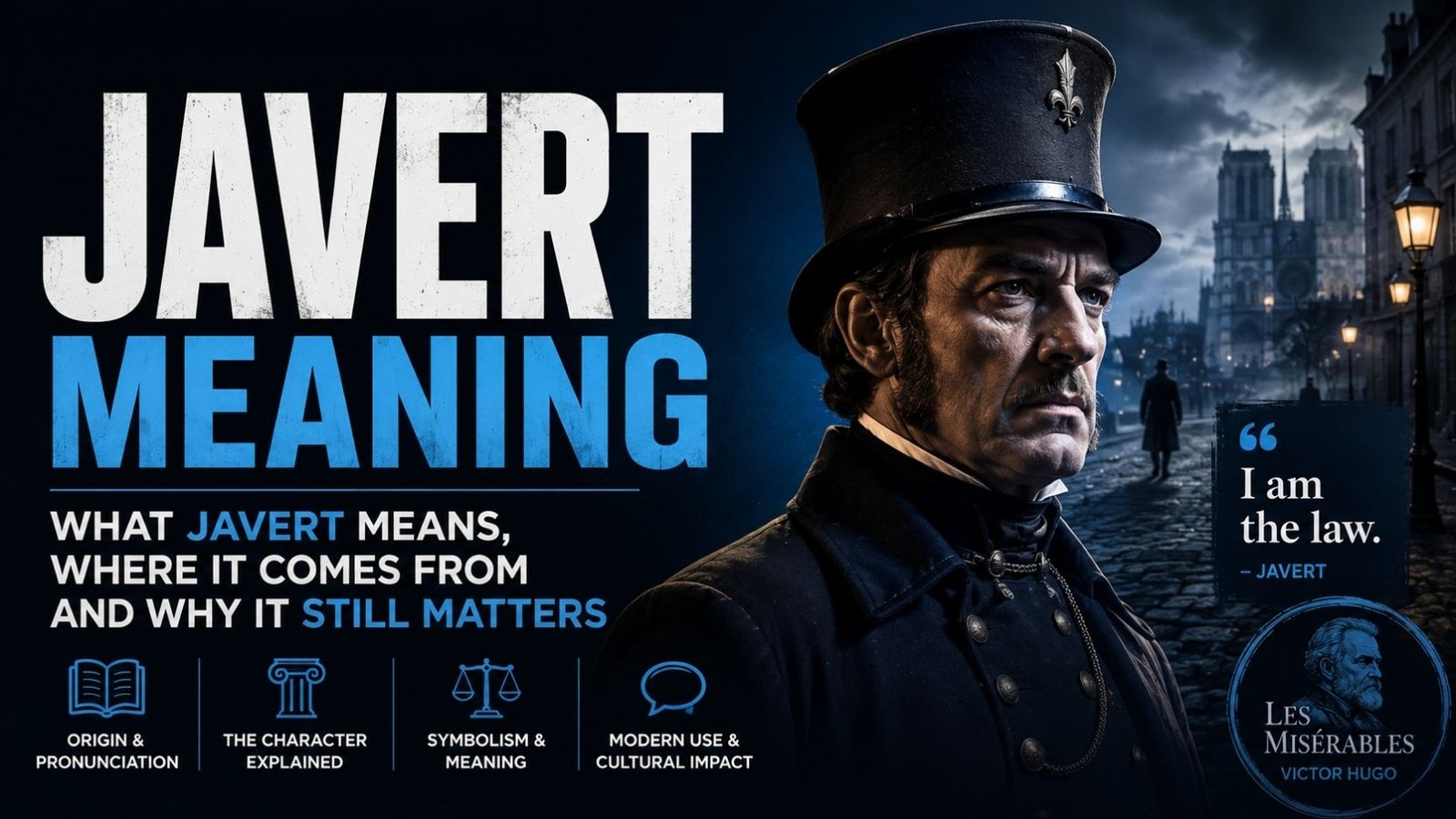
Javert meaning refers to the name of Inspector Javert, the relentless police officer from Victor Hugo’s 1862 novel Les Misérables. The name itself is a French surname with no fixed dictionary definition, but the character has come to symbolize rigid, unforgiving devotion to law over mercy. This guide covers the name’s pronunciation, its French roots, the character’s story, and why “Javert” keeps trending in online searches today.
Quick Answer Box
Javert is a proper noun, not a common English word. It is the surname of a fictional French police inspector created by Victor Hugo. There is no literal dictionary translation, but the name has become shorthand for someone inflexible, obsessed with rules, and unable to accept moral nuance.
| Quick Fact | Detail |
| Type of word | Proper noun, a surname |
| Language of origin | French |
| Pronunciation | zha VAIR (French: ʒavɛʁ) |
| First appeared | Les Misérables by Victor Hugo, 1862 |
| Character role | Police inspector, main antagonist |
| Symbolic meaning | Blind devotion to law over compassion |
| Modern usage | NYT Connections puzzle answer, cultural shorthand for rigid rule following |
What Does Javert Mean?
Javert does not have a standard dictionary meaning the way words like “justice” or “mercy” do. It is a proper name, so most language authorities classify it as a surname rather than a vocabulary term. What people are usually really asking when they search “Javert meaning” is either what the name symbolizes in the story, or how the word is used outside the book.
In Les Misérables, Javert is introduced without a first name at all. He simply appears as “Javert,” a police officer whose entire identity is built around enforcing the law without exception. Because the name carries no first name and very little personal history, readers naturally search for a deeper meaning behind it, assuming Hugo chose the name deliberately.
That assumption is reasonable. Hugo was known for embedding meaning into names throughout the novel, and Javert is widely treated by literature scholars as a name chosen to reflect the character’s harsh, unyielding nature rather than a name with a literal translation.
Javert Meaning In English
There is no English translation for Javert because it was never an English word to begin with. It is a French surname that Hugo used as a character name, and it has since entered English purely as a proper noun tied to this specific fictional inspector.
When people search “Javert meaning in English,” they are usually looking for one of two things. Either they want to understand what the name represents thematically within the novel, or they encountered the word somewhere unrelated to the book, such as a puzzle or a piece of commentary, and want context.
For everyday English usage, Javert functions almost like an eponym, a proper name that has taken on a broader descriptive meaning. Much like calling someone “a real Scrooge” evokes stinginess, calling someone “a Javert” evokes an obsessive, by the book enforcer who refuses to bend even when bending would be the humane choice.
How To Pronounce Javert
Getting the pronunciation right matters, especially since Javert is a French name being used constantly by English-speaking readers, students, and puzzle fans. The correct French pronunciation is close to zha VAIR, with the emphasis on the second syllable.
Quick Tip Box: Javert Pronunciation
- French IPA: ʒavɛʁ
- Say it like: “zha” (as in the “s” sound in “measure”) plus “VAIR” (rhymes with “hair” but softer)
- Do not pronounce the final “t”
- Do not pronounce it like the English word “javelin,” even though the spellings look similar
Many English speakers instinctively want to pronounce the “t” at the end because that is how English works, but French typically drops final consonants like this. Practicing the name out loud a few times, focusing on that soft “zh” sound at the start, will get you very close to how Hugo’s original French readers would have said it.
Javert Meaning In French
In French, Javert functions purely as a surname, similar to how Smith or Johnson function in English. It is not a common word you would find defined in a standard French dictionary the way you would find a word like “amour” or “justice.”
Language researchers who have traced the name’s roots point to a few real French place names and surnames that may have inspired Hugo, including the small French localities of Javerlhac and Javerdat. This suggests the name likely functioned the way many French surnames do, originating from a family’s connection to a specific place rather than carrying an inherent symbolic meaning on its own.
Note Box: No verified etymological dictionary confirms a single definitive origin for the surname Javert. Several plausible theories exist, but readers should treat any single explanation as informed speculation rather than settled fact.
Who Is Inspector Javert? A Complete Character Overview
Inspector Javert is one of the most iconic antagonists in French literature, appearing throughout Victor Hugo’s sprawling novel Les Misérables. He begins the story as a prison guard at the Toulon galleys, where he first encounters Jean Valjean, the novel’s protagonist and a paroled convict.
Javert later rises to the rank of police inspector, and from that point on, his life becomes consumed by tracking down Valjean after Valjean breaks parole. This pursuit stretches across decades of the story, following Valjean through different cities, disguises, and identities, and it forms one of the central conflicts driving the entire novel.
What makes Javert compelling rather than simply villainous is his internal logic. He genuinely believes that upholding the law is the highest possible moral good, and he applies that belief to himself just as harshly as he applies it to others. He is not corrupt, not cruel for pleasure, and not motivated by personal gain, which is part of why readers and scholars still debate him more than 160 years later.
| Character Detail | Description |
| Full role | Prison guard, later police inspector |
| Nationality | French |
| Religion | Catholic |
| Family background | Son of a convict father and a fortune teller mother |
| Core belief | The law is absolute and infallible |
| Main conflict | Lifelong pursuit of Jean Valjean |
| Fate | Dies by suicide after his worldview collapses |
The Origin Of The Name Javert
Victor Hugo rarely chose character names carelessly, and Javert is a strong example of that pattern. Within the novel itself, Hugo offers a striking passage suggesting that Javert’s name and nature are tied to a folk belief from the Asturias region of northern Spain, where peasants believed that every litter of wolves contained one dog, which the mother would kill because it would otherwise grow up and devour the other pups.
Hugo essentially describes Javert as that dog given a human face, a creature caught between two worlds, disciplined and loyal like a domestic animal, but sharp and merciless like a predator. This origin story is less about literal etymology and more about symbolic meaning, and it is one of the clearest windows into how Hugo wanted readers to understand the character before Javert ever speaks a word.
Beyond Hugo’s own symbolic explanation, name researchers have floated other possibilities, including a connection to Spanish names like Javier or Xavier, or even a distant link to the Arabic name Jafar. None of these alternate theories have been definitively proven, so the most reliable explanation remains the one Hugo wrote directly into the text.
Definition Box: The Asturian Wolf Legend Hugo used a Spanish folk belief about wolf litters producing one dog like offspring to explain Javert’s dual nature, part loyal enforcer, part relentless predator. This passage is widely cited by literature scholars as the most direct clue Hugo gave about the meaning behind the name.
Javert As A Symbol: What the Character Represents
Javert’s real significance goes far beyond his literal name. Literary analysts consistently describe him as the embodiment of rigid legalism, the belief that whatever the law says is automatically right, with no room for context, mercy, or human error.
This matters because Javert is not written as a cartoonish villain. He is intelligent, disciplined, and even admirable in his consistency, which is exactly what makes his eventual downfall so powerful. Hugo uses Javert to ask a difficult question that still resonates today: what happens to a person who has built their entire identity around a system that turns out to be incomplete?
Javert’s worldview rests on two simple ideas that Hugo describes directly: respect for authority and hatred of rebellion, carried to such an extreme that they become almost harmful rather than virtuous. When those two ideas are pushed too far, every crime becomes indistinguishable from rebellion in Javert’s mind, leaving no space for context like poverty, desperation, or redemption.
Why Did Javert Kill Himself? The Full Explanation
Javert’s suicide is one of the most analyzed moments in Les Misérables, and it happens because Jean Valjean spares his life during a violent uprising rather than taking revenge for years of relentless pursuit. This single act of mercy destroys Javert’s entire understanding of how the world is supposed to work.
Javert had spent his whole life believing that criminals were incapable of goodness and that the law was always morally correct. When Valjean, a man Javert has hunted for decades, chooses compassion over vengeance, Javert is confronted with undeniable proof that a so called criminal can be more moral than the law itself allows for.
He cannot reconcile owing his life to a man he considers a criminal, and he cannot bring himself to arrest Valjean either, since doing so would betray the debt of mercy he now owes him. Trapped between two impossible choices, betraying his own principles by letting Valjean go free, or betraying his sense of gratitude by arresting him, Javert sees no way to keep living with integrity intact.
Quick Tip Box: The Two Core Reasons Javert Dies
- He cannot comprehend or accept the mercy Valjean shows him
- He cannot forgive himself for failing what he saw as his sacred duty to enforce the law
In the novel, Javert ultimately throws himself into the Seine River in Paris, choosing death over living inside a moral contradiction he has no framework to process. It is described not as an act of panic, but as a calm, almost logical decision, consistent with how methodically Javert approached everything else in his life.
Javert In The Stage Musical vs the Original Novel
The stage musical version of Les Misérables, with music by Claude Michel Schönberg and a book by Alain Boublil, first premiered in Paris in 1980 before reaching London audiences in 1985. It keeps Javert’s core motivations intact while giving him two standout songs that have become famous well beyond theater audiences.
The first, “Stars,” is Javert’s early soliloquy where he compares the unshakable order of the law to the fixed, unchanging position of the stars in the night sky. It is one of the clearest musical expressions of his worldview, showing why the character resonates with audiences who have never read Hugo’s original 850 page novel.
The second major number, often referred to as “Javert’s Suicide,” dramatizes his final unraveling after Valjean spares him. The lyrics capture his internal collapse in real time, expressing disbelief that mercy from a convict could feel more devastating than any physical defeat, which is why this scene remains one of the most emotionally intense moments in modern musical theater.
| Version | Focus | Key Moment |
| 1862 Novel | Deep internal philosophy and moral debate | Extended internal monologue before his death |
| Stage Musical | Emotional, musical expression of his worldview | “Stars” and “Javert’s Suicide” |
| Film Adaptations | Visual and dramatic tension between Valjean and Javert | The bridge or riverside confrontation |
Javert Meaning In NYT Connections
One major reason “Javert meaning” has been trending recently has nothing to do with literature class and everything to do with the popular New York Times word game Connections. In a puzzle released in March 2026, Javert appeared as part of a category grouping fictional inspectors together.
That specific blue difficulty group was titled “Fictional Inspectors,” and it paired Javert with three other well known fictional detectives, Inspector Clouseau from the Pink Panther films, Inspector Gadget from the animated series, and Inspector Morse from the British detective drama. Many players recognized Clouseau, Gadget, and Morse instantly but had never encountered Javert by name before, which sent a wave of curious players searching “Javert meaning” and “inspector Javert meaning” right after finishing the puzzle.
Definition Box: That Day’s Connections Categories
- Yellow: Hypnotic state, including dream, haze, spell, and trance
- Green: Words starting with prefixes meaning two, including binary, dioxide, duolingo, and twilight
- Blue: Fictional inspectors, including Clouseau, Gadget, Javert, and Morse
- Purple: Words ending in hidden female animal names, including hootenanny, lichen, Moscow, and nightmare
This context also explains a few oddly specific related searches, like “Javert meaning duolingo,” “Javert meaning clouseau,” “Javert meaning hootenanny,” and “Javert meaning lichen.” These are not actually connected to Javert’s meaning at all. They come from players who solved the puzzle and searched leftover words from the same grid together, sometimes without realizing the words belonged to entirely separate categories.
Javert Meaning In Slang And Everyday Pop Culture Usage
Outside of the novel and the puzzle world, Javert has slowly picked up informal, conversational usage as a kind of shorthand. When someone is described as being “such a Javert” or having “Javert energy,” the speaker is usually pointing at a person who follows rules with zero flexibility, even when doing so causes obvious harm or seems needlessly harsh.
This kind of usage falls into a well established pattern in English where a fictional character’s name becomes an adjective like descriptor for a personality trait, similar to calling an overly cautious person “a real Chicken Little” or calling a hopeless romantic “a total Cyrano.” It is informal, culturally dependent, and not something you will find in a formal dictionary entry, but it is genuinely how the name gets used in modern conversation, especially among readers, theater fans, and literature students.
Warning Box: Slang usage of Javert varies widely by community and is not standardized the way formal dictionary definitions are. Always rely on context clues from the conversation rather than assuming a single fixed slang meaning applies everywhere.
Javert Vs Other Fictional Inspectors: A Quick Comparison
Since Javert is frequently grouped with other famous fictional detectives, especially after the Connections puzzle mentioned above, it helps to see how he actually compares to them in tone and purpose.
| Inspector | Source Material | Personality Type | Tone of the Work |
| Javert | Les Misérables, 1862 novel | Rigid, tragic, morally serious | Dramatic literary fiction |
| Inspector Clouseau | The Pink Panther films | Bumbling, comedic, accident-prone | Slapstick comedy |
| Inspector Gadget | Animated television series | Well meaning, gadget-reliant, oblivious | Family friendly comedy |
| Inspector Morse | British detective drama | Intellectual, methodical, humane | Serious detective drama |
This comparison highlights exactly why so many puzzle players were stumped by Javert specifically. Clouseau, Gadget, and Morse are all comedic or television-leaning characters most casual audiences recognize instantly, while Javert comes from a dense literary classic that fewer people have read cover to cover, even if they have seen a film or stage adaptation.
Common Misspellings And Related Search Confusion
A number of related searches show up around this topic that deserve a straightforward explanation rather than a guess. Terms like “Javerty meaning” are simply common misspellings of Javert, with no separate meaning of their own.
Searches like “Javert code meaning” and “Javert meaning code” do not correspond to any confirmed, verified reference tied to the character or the novel. Rather than inventing an explanation, the most honest answer is that no reliable source currently defines a specific “Javert code,” and readers encountering that phrase should treat it with caution until a credible source clarifies it.
Similarly, “Javert stars meaning” almost always refers back to the musical’s song “Stars,” where Javert compares moral order to the fixed positions of the stars, rather than any separate standalone meaning of the word stars itself.
Frequently Asked Questions
What does the name Javert mean?
Javert is a French surname used by Victor Hugo for his police inspector character in Les Misérables. It has no fixed dictionary translation but symbolizes rigid devotion to law.
How do you pronounce Javert in English?
Most English speakers say it as zha VAIR, following the French pronunciation, without pronouncing the final “t.”
Is Javert a real French word?
No, Javert functions as a surname rather than a common vocabulary word in French.
Why did Javert kill himself in Les Misérables?
He could not reconcile Jean Valjean sparing his life with his lifelong belief that criminals deserved no mercy, leading to his suicide.
Is Javert the villain of Les Misérables?
He is generally considered the main antagonist, though scholars note he is not evil, just dangerously rigid in his beliefs.
Why was Javert in the NYT Connections puzzle?
He appeared in a “Fictional Inspectors” category alongside Clouseau, Gadget, and Morse in a March 2026 puzzle.
What does it mean to call someone “a Javert”?
It informally describes someone who follows rules so strictly that they ignore compassion, context, or fairness.
Does Javert have a first name in the novel?
No, Hugo never gives Javert a first name throughout the entire novel.
What is the meaning behind Javert in the musical’s song “Stars”?
Javert compares the unwavering order of the law to the fixed, unchanging stars in the night sky.
Where did Victor Hugo get the name Javert from?
Hugo links Javert symbolically to an Asturian folk legend about wolf litters, though the literal surname may trace to small French place names like Javerlhac.
Final Takeaway
Javert meaning ultimately comes down to two layers, the literal and the symbolic. Literally, it is a French surname with no fixed translation, likely rooted in regional place names rather than a dictionary definition.
Symbolically, Javert represents something far more universal, the danger of following rules so rigidly that mercy, context, and human complexity get pushed aside entirely. That tension is exactly why the name keeps resurfacing, whether someone encounters it through Hugo’s original novel, a stage production, or an unexpected line in a daily word puzzle.

Zoya Ahmed is the author of Means Wiki, dedicated to making words, names, phrases, and slang easier to understand. With 4 years of experience, she researches and writes simple, accurate, and useful explanations to help readers quickly discover meanings and better understand everyday language.