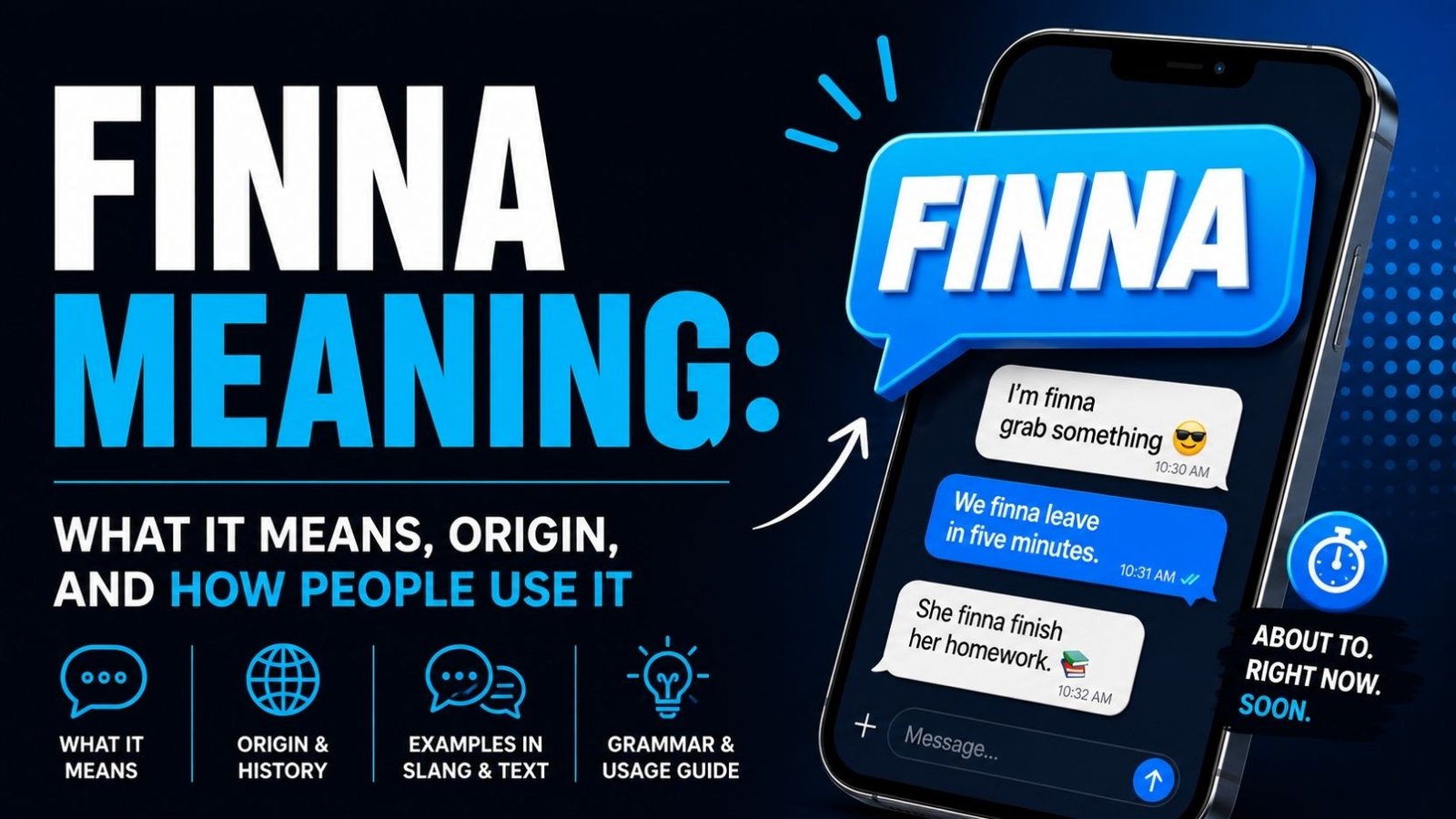
If you have seen the word “finna” in a text, a tweet, or a song lyric, you were probably looking for a quick, clear answer. Finna means “about to” or “going to.” It signals that someone is on the verge of doing something, usually very soon. When someone says “I’m finna eat,” they mean “I’m about to eat.”
This word is not new, even though it feels like a fresh piece of internet slang. It comes from African American Vernacular English, and it has been part of everyday speech for generations. Understanding where it came from helps you understand why it works the way it does, and why it is not simply a shortcut or a typo.
What Does Finna Mean?
Finna is a short way of saying that an action is about to happen. It works like “about to,” “going to,” or the more casual “gonna.”
Here is the simplest way to think about it: if you are finna do something, you are already moving toward doing it. The action feels close, almost immediate, rather than a distant plan.
- “I’m finna call her back.” → I’m about to call her back.
- “We finna leave in five minutes.” → We’re going to leave in five minutes.
- “She finna finish her homework.” → She’s about to finish her homework.
Finna almost always comes right before a verb. That verb tells you what action is coming up.
See More: IGU Meaning Text
Finna Meaning In Slang
In slang usage, finna carries a sense of immediacy that plain phrases like “going to” sometimes lack. Saying “I’m going to clean my room” can mean anytime today. Saying “I’m finna clean my room” suggests you are starting right now, or within the next few minutes.
That immediacy is part of why finna caught on so widely. It is efficient. One syllable-and-a-half replaces a whole phrase, and it still carries emotional weight, urgency, or emphasis depending on tone.
Finna is also flexible. It shows up in casual texting, social media captions, song lyrics, and everyday spoken conversation. It rarely appears in formal writing, and that is expected, since it is an informal, spoken-language form rather than a standard written one.
Finna Meaning Origin
Finna comes from the phrase “fixing to.” In many varieties of Southern American English, “fixing to” has long meant “getting ready to” or “about to.”
Over time, through natural contraction in fast, casual speech, “fixing to” became “fixin’ to,” and eventually collapsed further into “finna.” This kind of shortening is common in spoken language. English does it constantly: “going to” became “gonna,” and “want to” became “wanna.”
Finna is most strongly associated with African American Vernacular English, often shortened to AAVE. AAVE is a fully rule-governed dialect of English with its own consistent grammar, not a collection of errors or slang alone. Linguists have studied AAVE for decades and recognize it as a legitimate linguistic system with patterns just as structured as those in formal English.
Researchers Julia Thomas and Timothy Grinsell, linguists at the University of Chicago, studied the spread and use of “finna” alongside related forms like “finta” and “fitna.” Their work noted that “finna” and similar future-marking words like “gonna” and “bouta” (from “about to”) have sometimes carried subtly different shades of meaning, even though they all point toward the near future.
Finna spread beyond AAVE-speaking communities through music, television, and later social media. Platforms like Twitter, TikTok, and Instagram accelerated its reach, introducing it to younger generations across many different backgrounds. This is a common pattern in language: words move from one speech community into broader popular use through media and cultural exchange.
Finna Meaning Grammar
Finna functions as what linguists call an aspect marker. In plain terms, that means it signals the timing and stage of an action rather than working as a standalone verb.
Specifically, finna marks the “immediate future” or “prospective aspect.” It tells the listener that an action has not started yet, but it is about to.
How it works in a sentence:
Finna is placed directly before the main verb, usually after a subject and a linking word like “I’m,” “you’re,” “we’re,” or a name.
| Pattern | Example | Meaning |
| Subject + finna + verb | “I finna go” | I am about to go |
| Subject + ‘m/’re + finna + verb | “I’m finna go” | I am about to go |
| Negative form | “I ain’t finna go” | I am not about to go |
Both “I finna go” and “I’m finna go” are used in casual speech. The version with “I’m” is more common in writing and texting because it reads more smoothly, but both are understood the same way.
Finna in Different Persons
Finna does not change form based on who is doing the action. Unlike standard English verbs, which often shift with the subject (“I go” versus “she goes”), finna stays the same no matter the subject.
- I’m finna leave.
- You finna leave.
- He finna leave.
- She finna leave.
- We finna leave.
- They finna leave.
This consistency is a normal feature of AAVE grammar, not a mistake. Many dialects and languages simplify verb agreement in ways that standard English does not, and that simplification follows its own internal logic.
See More: BG Meaning
I’m Finna Meaning
“I’m finna” is one of the most common forms you will see. It simply means “I’m about to” or “I’m going to.”
- “I’m finna head to the gym.” → I’m about to head to the gym.
- “I’m finna text him back.” → I’m about to text him back.
- “I’m finna fall asleep.” → I’m about to fall asleep.
This form works well in first-person statements about plans, intentions, or actions that are starting very soon.
Ain’t Finna Meaning
“Ain’t finna” is the negative form. It means “not about to” or “not going to,” often with a stronger, more determined tone than a plain “won’t.”
- “I ain’t finna argue about this.” → I’m not going to argue about this.
- “She ain’t finna show up late again.” → She’s not going to show up late again.
This phrase often carries a sense of firmness or refusal. It is not just describing the future; it is expressing that the speaker has decided against something.
Finna Meaning Examples
Seeing finna in full sentences makes the meaning click faster than definitions alone.
- “I’m finna cook dinner, you hungry?” → I’m about to cook dinner, are you hungry?
- “They finna announce the winner.” → They’re about to announce the winner.
- “You finna regret that.” → You’re going to regret that.
- “We finna watch the game at my place.” → We’re about to watch the game at my place.
- “He said he’s finna quit his job.” → He said he’s about to quit his job.
Notice that finna always points forward. It never describes something that already happened or something happening right now; it describes something on the verge of happening.
Finna Meaning In Text And Chat
In texting and online chat, finna works the same way it does in speech. It is written the way it sounds, without extra punctuation or explanation needed.
- “omw, finna leave now” → On my way, I’m about to leave now.
- “finna eat then call u” → About to eat, then I’ll call you.
Because texting favors short, fast language, finna fits naturally. It communicates intention in one word instead of a full phrase like “I am about to.”
Finna Meaning Gen Z
Gen Z did not invent finna, but the generation helped push it into mainstream, cross-cultural use through social media. TikTok captions, tweets, and short-form video comments introduced the word to audiences who may not have grown up around AAVE.
For Gen Z speakers, finna often functions as an all-purpose way to announce an upcoming action, sometimes for genuine plans and sometimes for comedic or exaggerated effect, such as “I’m finna cry” to express strong emotion rather than literal tears.
Because finna originates in AAVE, some linguists and cultural commentators have raised concerns about words like this being used casually by people outside the community without awareness of that background. Knowing the origin, as covered above, is a simple way to use the word with more understanding.
Finna Vs Gonna Vs Bouta
These three words all point to the future, but they are not always interchangeable in feel or emphasis.
| Word | Comes From | Typical Feel |
| Finna | Fixing to | Immediate, close in time |
| Gonna | Going to | General future, can be near or distant |
| Bouta | About to | Very immediate, almost happening now |
“I’m gonna visit my grandma next month” sounds natural because gonna can stretch across a longer timeframe. “I’m finna visit my grandma next month” sounds odd, because finna leans toward something happening very soon, not weeks away.
Common Mistakes With Finna
Incorrect: Using finna to describe something already completed. “I finna ate lunch.” This does not work, because finna only points forward, never backward.
Correct: “I already ate lunch,” or “I’m finna eat lunch” if the meal has not happened yet.
Incorrect: Treating finna as a standalone verb with no following action. “I’m finna.” This leaves the sentence incomplete, since finna needs a verb after it to explain what is about to happen.
Correct: “I’m finna leave,” “I’m finna sleep,” or any verb that finishes the thought.
Incorrect: Assuming finna is only internet slang with no real linguistic structure. Finna follows consistent grammatical rules within AAVE; it is not random or careless language.
How to Pronounce Finna
Finna is pronounced “FIH-nuh,” with the stress on the first syllable. It rhymes with words like “dinner” or “winner,” but with an “f” sound at the start instead.
There is no silent letter and no tricky vowel shift. It is spoken exactly as it looks, which is part of why it transitions so easily into texting and casual writing.
See More: OMP Meaning
Similar Words And Related Slang
Finna belongs to a small family of contracted future-tense expressions that share a similar job in casual English.
| Word | Meaning | Example |
| Gonna | Going to | “I’m gonna call you later.” |
| Bouta | About to | “I’m bouta head out.” |
| Finna | Fixing to / about to | “I’m finna head out.” |
| Tryna | Trying to | “I’m tryna finish this project.” |
Each word softens or compresses a longer phrase into something faster to say. Finna stands out slightly because its roots trace specifically to “fixing to,” giving it a distinct Southern and AAVE history that the others do not share in quite the same way.
Frequently Asked Questions
What does finna mean?
Finna means “about to” or “going to.” It signals that an action is happening very soon.
Is finna a real word?
Yes. It is a recognized part of African American Vernacular English, a fully structured dialect with consistent grammar rules. It is informal, not standard written English, but that does not make it any less real as a word.
What part of speech is finna?
Finna functions as an aspect marker, a grammatical element placed before a verb to show that the action is about to start. It is not a noun, adjective, or standalone verb.
Where did finna come from?
Finna comes from the Southern American English phrase “fixing to,” shortened through natural speech patterns into “fixin’ to” and then “finna.” It is strongly associated with African American Vernacular English.
Is finna the same as gonna?
They are similar, but finna usually implies something more immediate. Gonna can describe plans further in the future, while finna suggests the action is starting very soon.
How do you use finna in a sentence?
Place finna directly before a verb, usually after a subject: “I’m finna leave,” “She finna call you,” “We finna eat.”
Is it okay to use finna in formal writing?
No. Finna is an informal, spoken-language word. It fits texting, casual conversation, and social media, but not formal essays, business writing, or academic work.
What does ain’t finna mean?
It means “not about to” or “not going to,” often with a firm or determined tone, such as refusing to do something.
Why do people say finna instead of about to?
Finna is shorter, faster to say, and carries a natural rhythm in casual speech. It also carries cultural and linguistic identity tied to AAVE.
Does finna have multiple spellings?
The standard spelling is “finna.” Related but distinct forms like “finta” and “fitna” appear in some regional and historical usage, though “finna” is by far the most common today.
Final Thoughts
Finna means “about to” or “going to,” and it works by sitting directly before a verb to show that an action is close at hand. It grew out of the Southern phrase “fixing to,” shaped over time by African American Vernacular English into the short, punchy word people use today across texting, music, and everyday conversation.
Understanding finna is less about memorizing a definition and more about recognizing it as part of a real, structured dialect with its own history. Whether you hear it in a song, see it in a text, or use it yourself, finna is a clear, efficient way to say that something is just about to happen.

Zoya Ahmed is the author of Means Wiki, dedicated to making words, names, phrases, and slang easier to understand. With 4 years of experience, she researches and writes simple, accurate, and useful explanations to help readers quickly discover meanings and better understand everyday language.

3 Comments