
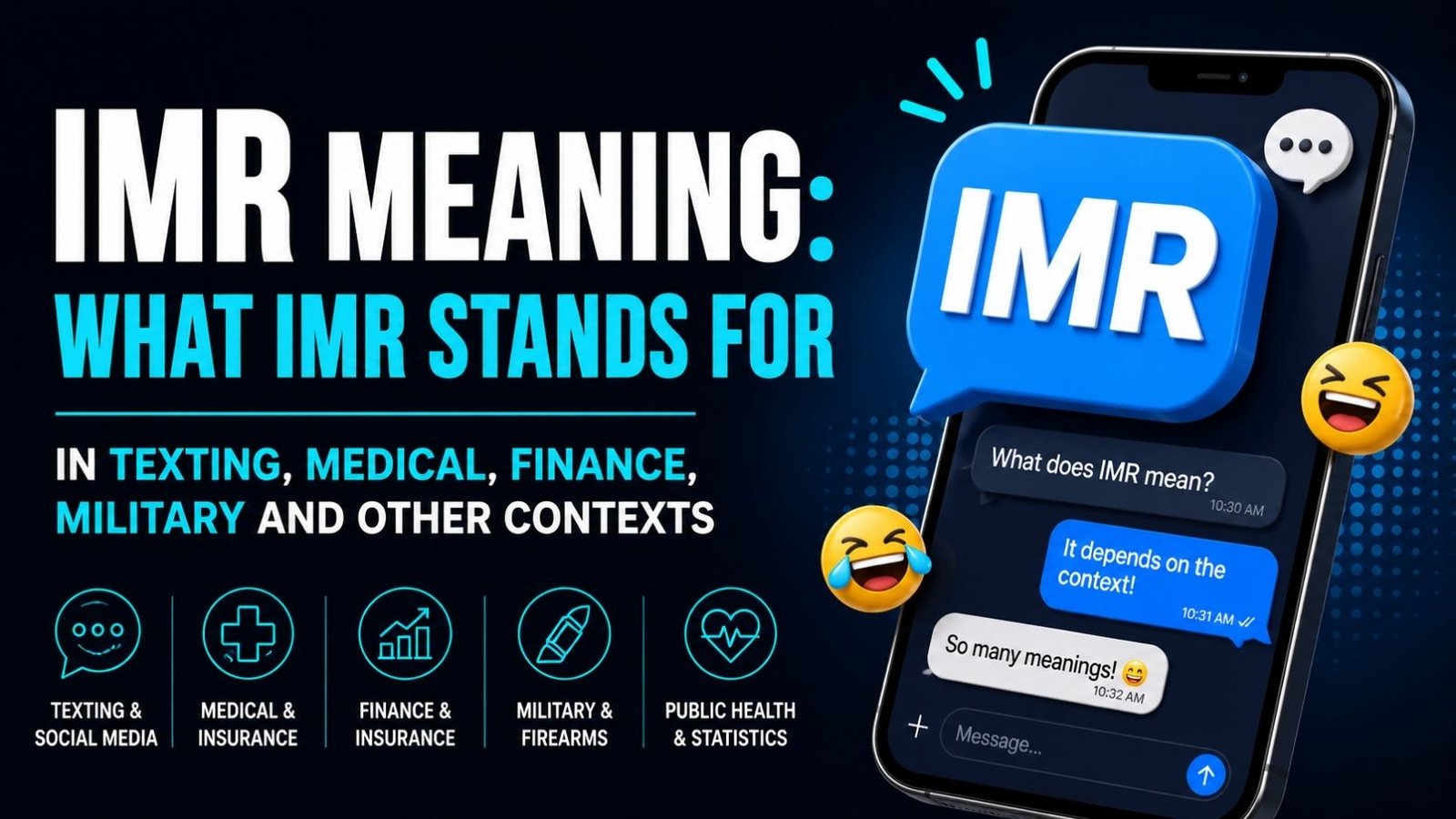
IMR is one of those short abbreviations that means something completely different depending on where you see it. There is no single, universal answer to “what does IMR mean.”
In healthcare and insurance, IMR almost always refers to Independent Medical Review, a formal process used to settle disputes over denied medical treatment. In the insurance and finance world, IMR usually stands for Interest Maintenance Reserve, an accounting requirement for life insurers. Among shooters and reloaders, IMR is a well-known gunpowder brand short for Improved Military Rifle. In public health writing, IMR can mean Infant Mortality Rate.
In texting and social media, the picture is much less clear. Several sites claim IMR means things like “I Mean, Really” or “I’m Mad Right Now,” but these definitions conflict with each other and are not backed by any established slang dictionary. This guide walks through every context where IMR actually shows up, gives you the meaning you can trust in each one, and is honest about where the evidence runs out.
Quick Answer: What Does IMR Mean?
There is no single fixed meaning. IMR is an initialism, not a word, so its meaning changes based on context. Here is the short version before the detailed breakdown:
| Context | What IMR Usually Means |
| Healthcare and insurance | Independent Medical Review |
| Workers’ compensation | Independent Medical Review |
| Insurance and finance | Interest Maintenance Reserve |
| Firearms and reloading | Improved Military Rifle (a gunpowder brand) |
| Public health statistics | Infant Mortality Rate |
| Texting and social media | Disputed; no confirmed single meaning |
If you saw IMR in a specific setting, jump to that section below. If you saw it in a text message from a friend, read the texting section carefully. That is the context where the meaning is genuinely uncertain, and it is worth understanding why.
See More: FWIW Meaning
IMR Meaning In Medical And Insurance Contexts
The clearest, best documented meaning of IMR is Independent Medical Review.
An Independent Medical Review is a process where a licensed, independent physician evaluates a medical case to decide whether a treatment should be approved, denied, or overturned. It is used when a patient or a treating doctor disagrees with an insurance company’s decision to deny, delay, or modify a requested treatment.
The independent reviewer has no connection to the insurer or the treating physician. That separation is the entire point of the process. It is meant to give patients an outside, unbiased opinion instead of leaving the final decision with the same company that denied the claim in the first place.
How Independent Medical Review Works
The process generally follows a similar pattern across states and insurers:
- A treatment request is denied, delayed, or modified. This usually happens after a step called Utilization Review, where an insurer checks whether a treatment is medically necessary.
- The patient or provider disagrees with that decision. They can then file a formal request for an Independent Medical Review.
- An independent, board-certified physician is assigned. This doctor works in the same specialty as the treatment in question and has no prior relationship with the case.
- The reviewer examines the medical records. They evaluate treatment guidelines, clinical evidence, and the specifics of the case, generally without a physical examination of the patient.
- A binding decision is issued. In many states, the outcome of an IMR is final and cannot be appealed further through the same channel.
California is one of the most well-documented examples of this system. The California Department of Insurance and the state’s Division of Workers’ Compensation both run structured Independent Medical Review programs, and the state’s workers’ compensation system has used IMR to resolve treatment disputes since July 2013.
IMR Is Not The Same As An IME
People sometimes confuse IMR with IME, or Independent Medical Examination. They sound alike, but they are different steps.
| Term | What It Involves | When It Happens |
| IME (Independent Medical Examination) | A physical exam of the patient by an independent doctor | Usually requested by an employer or insurer during a claim |
| IMR (Independent Medical Review) | A records-only review of a denied or disputed treatment | Requested after a treatment has already been denied |
An IME involves a doctor physically examining the patient. An IMR is typically a review of paperwork and medical records, without a new physical exam. Knowing this difference matters if you are dealing with a workers’ compensation claim or an insurance dispute, since the two processes serve different purposes.
Success Rates And What to Expect
If you are the one requesting an IMR, it helps to know that reviewers uphold the original denial more often than they overturn it. Reporting from California’s workers’ compensation system has shown that IMR decisions have historically sided with the insurer’s original Utilization Review determination in roughly nine out of ten cases. That does not mean the process is not worth pursuing. It does mean that having strong medical documentation before you file matters a great deal.
IMR Meaning In Finance And Insurance Accounting
Outside of medical disputes, IMR has a completely different meaning inside insurance company accounting: Interest Maintenance Reserve.
This is a liability reserve that U.S. life insurance companies are required to maintain under rules set by the National Association of Insurance Commissioners, or NAIC. Its purpose is narrow but important: it smooths out the effect that changing interest rates have on an insurer’s reported financial strength.
Here is the plain-English version of why it exists. When interest rates fall, an insurer that sells older, higher-yield bonds and reinvests in newer, lower-yield bonds will show an immediate paper gain.
Without a rule like IMR, that gain would show up all at once on the insurer’s books, making the company look more financially secure than it actually is on an ongoing basis. IMR requires that gain to be spread out, or amortized, over the remaining life of the investments involved, so the reported numbers reflect reality more accurately over time.
A few practical points about IMR in this context:
- It applies specifically to realized gains and losses tied to interest rate movements on fixed income investments such as bonds.
- It does not apply to gains or losses from stock investments or from a bond issuer defaulting.
- Regulators have been actively discussing how to handle negative IMR balances in recent years, particularly as interest rate environments have shifted.
If you work in insurance, actuarial services, or financial reporting, this is very likely the IMR you are dealing with, not any of the other meanings on this page.
See More: Javert Meaning
IMR Meaning In Firearms And Ammunition Reloading
Among people who reload their own ammunition or shoot competitively, IMR refers to a specific, well-known brand of smokeless gunpowder: Improved Military Rifle.
The name traces back to the early 1900s. E.I. du Pont de Nemours and Company, commonly known as DuPont, developed these powders from World War I through World War II for loading military and commercial rifle cartridges. The powders were later sold to civilians for reloading ammunition used in hunting and target shooting.
IMR powders are typically labeled with numbers rather than words, such as IMR 4064, IMR 4350, or IMR 8208 XBR. Each number identifies a specific formulation with its own burn rate and characteristics, which matters a great deal to reloaders trying to match a powder to a particular cartridge and use case. The IMR brand has continued to develop new powder formulas over the decades and is still actively sold today.
If you came across “IMR” on a box of gunpowder, a reloading forum, or a hunting supply website, this is almost certainly the meaning you are looking for.
IMR Meaning In Public Health: Infant Mortality Rate
In public health research and government statistics, IMR commonly stands for Infant Mortality Rate.
This is a standard demographic and health statistic that measures the number of infant deaths, typically before the age of one, per a set number of live births in a given population and time period. It is a widely used indicator when comparing healthcare access, maternal health outcomes, and overall public health conditions between countries, regions, or time periods.
You are most likely to encounter this meaning of IMR in academic papers, government health reports, or global health datasets rather than in casual conversation.
IMR In Gaming: Matchmaking And Skill Rating
In some online gaming communities, particularly around competitive multiplayer games, you may see IMR used alongside or confused with MMR, which stands for Matchmaking Rating. MMR is a number that represents a player’s skill level and is used to match players of similar ability against each other.
Some games and communities use variations of this term, including individual rating systems that track a single player’s performance separately from their team’s overall rating.
If you saw “IMR” in a gaming context next to terms like MMR, rank, or matchmaking, it is very likely part of this skill-rating conversation rather than any of the meanings above. Because terminology varies by game and community, it is worth checking the specific game’s own glossary or wiki if precision matters for your situation.
IMR Meaning In Texting And Social Media: What We Actually Know
This is the context most people searching for “IMR meaning” are actually curious about, and it deserves an honest answer rather than a confident-sounding guess.
Here is the situation. A number of recently published slang and texting guides claim IMR has a specific meaning in casual conversation. The problem is that these sources do not agree with each other. Different pages, sometimes published within weeks of one another, define IMR as:
- “I Mean, Really”
- “I’m Mad Right Now”
- “I Mean, Right?”
- “In My Room”
- “I Might Respond”
- “I’m Ready” or “I’m Really”
None of these definitions is confirmed by an established slang reference, and no single one shows up consistently enough across reliable sources to call it “the” meaning. That pattern, several competing explanations with no clear agreement, is a strong sign that IMR has not settled into one widely recognized meaning the way abbreviations like IKR (“I know, right”) or NGL (“not gonna lie”) have.
What This Means For You As A Reader
If someone sends you “IMR” in a text and you are not sure what they mean, the most reliable approach is simple: ask them, or read it in the context of the rest of the conversation.
Because there is no confirmed standard meaning, the safest interpretation is whichever phrase makes sense given what was just said. If your friend just told you something surprising and replied “IMR,” it is reasonable to read that as some form of emphasis or reaction. Beyond that, treating any specific expansion as the definitive meaning would be guessing, not reporting a fact.
This is also a useful reminder about internet slang in general. Not every three-letter combination you see online has a stable, agreed-upon meaning. Some abbreviations are genuinely widespread and consistent. Others are regional, personal to a friend group, or simply invented by content sites trying to explain a term that does not have a fixed definition yet. IMR, in its texting sense, currently falls into that second category.
IMR Vs Similar Terms People Confuse It With
A few other abbreviations look or sound similar to IMR and are worth telling apart.
| Term | Meaning | How It Differs From IMR |
| IMO | In My Opinion | A well-established, widely recognized opinion marker; not related to IMR |
| IKR | I Know, Right | A confirmed, common agreement expression in texting |
| IMRAD | Introduction, Methods, Results, And Discussion | A structure used for organizing academic research papers, unrelated to texting slang |
| MMR | Matchmaking Rating | A gaming skill rating term, sometimes mentioned near IMR in gaming contexts |
| IME | Independent Medical Examination | A physical exam step in medical or workers’ compensation claims, distinct from an IMR review |
IMRAD in particular is worth a quick note since it looks close to IMR. IMRAD is a standard format for scientific and academic papers: Introduction, Methods, Results, And Discussion. It is a well-documented, established term in academic writing, unlike the texting use of IMR.
Common Mistakes When Using or Interpreting IMR
❌ Assuming IMR always means the same thing across every conversation.
✅ Recognizing that IMR changes meaning based on context, medical, financial, firearms-related, or casual texting.
❌ Treating an unverified texting definition as a fact.
✅ Reading IMR in a text message based on the surrounding conversation rather than a fixed dictionary definition.
❌ Confusing an Independent Medical Review with an Independent Medical Examination.
✅ Remembering that an IMR is typically a records review, while an IME involves an actual physical exam.
❌ Using slang abbreviations like IMR in formal, professional, or medical writing.
✅ Spelling out the full term in professional contexts, since a reader in a workers’ compensation case or an insurance filing needs the standard meaning, not a texting guess.
See More: FRL Meaning Text
Frequently Asked Questions
What does IMR mean in a text message?
There is no single confirmed meaning. Several slang sites offer different guesses, such as “I Mean, Really” or “I’m Mad Right Now,” but none of these are backed by an established slang reference. The safest approach is to interpret it based on the conversation it appears in.
What does IMR mean in medical terms?
IMR most commonly stands for Independent Medical Review, a process where an independent physician reviews a denied or disputed medical treatment to decide whether it should be approved.
What is the difference between IMR and IME?
An IMR (Independent Medical Review) is typically a review of medical records and documentation. An IME (Independent Medical Examination) involves an independent doctor physically examining the patient. They serve different purposes in a medical or workers’ compensation claim.
What does IMR mean in finance or insurance?
In insurance accounting, IMR stands for Interest Maintenance Reserve, a required reserve that spreads out interest-rate-related investment gains and losses over time instead of recognizing them all at once.
What does IMR mean in firearms or reloading?
IMR stands for Improved Military Rifle, a well-known brand of smokeless gunpowder originally developed by DuPont and still sold today for rifle ammunition reloading.
Is IMR the same as IMRAD?
No. IMRAD refers to a structure used in academic papers (Introduction, Methods, Results, And Discussion). IMR, by contrast, has several separate meanings depending on context and is not a recognized abbreviation for that structure.
Is it safe to use IMR in a work or business email?
Only if you are referring to one of the established professional meanings, such as Independent Medical Review or Interest Maintenance Reserve, and even then it is best to spell out the full term the first time you use it. Avoid using IMR as texting slang in any formal or business communication.
What does IMR mean on Snapchat, TikTok, or Instagram?
The same uncertainty applies here as with general texting. Several guides claim specific meanings for these platforms, but none are confirmed by a reliable slang source. Context from the conversation is the most reliable guide.
Final Thoughts
IMR is not one word with one meaning. It is an abbreviation that different fields have independently adopted for their own purposes: doctors and insurers use it for Independent Medical Review, insurance accountants use it for Interest Maintenance Reserve, shooters and reloaders use it for a gunpowder brand, and public health researchers use it for Infant Mortality Rate.
The one place where IMR does not have a settled meaning is casual texting. If that is why you searched for this term, the most honest answer is that no single definition has been reliably established yet, despite what some guides claim. When in doubt, the context of the conversation will tell you more than any list of guesses will.

Zoya Ahmed is the author of Means Wiki, dedicated to making words, names, phrases, and slang easier to understand. With 4 years of experience, she researches and writes simple, accurate, and useful explanations to help readers quickly discover meanings and better understand everyday language.


One Comment